Scott Hahn: The Kingdom of God as Liturgical Empire

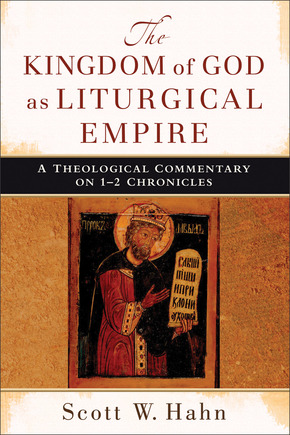
 Scott W. Hahn, The Kingdom of God as Liturgical Empire: A Theological Commentary on 1-2 Chronicles (Baker Academic, 2012).
The Kingdom of God as Liturgical Empire is Dr. Hahn’s finest work. This reviewer has read some of Hahn’s other works and has some of them in his personal library. He is a professor of Scripture and Theology at Franciscan University in Steubenville, Ohio, and holds the Pope Benedict XVI Chair of Theology at St. Vincent Seminary. Dr. Hahn has occasionally been part of the Evangelical Theological Society, where this reviewer has met him at a national gathering.
What Dr. Hahn maintains in this commentary is that First and Second Chronicles comprise not an history of Israel between the reigns of Saul, David, Solomon, and their successors up to the Babylonian Exile, but a liturgical recall of those events in order to evoke repentance and renewal of both the Kingdom and of the people of God. “The writing of Chronicles is an act of what the Hebrews called zakkor, an act of remembrance that aims to bring one into the living and vital contact with events recalled” (p. 2). The “why” of Israel’s history is the reason for Chronicles. The why lies in the well-known and often recited passage in 2 Chronicles 7:14, “if My people who are called by My name will humble themselves and pray and seek My face, and turn from their wicked ways, then I will hear from heaven, and will forgive their sin and heal their land.”

Hahn makes a very strong case for treating First and Second Chronicles as a liturgical recalling and retelling of Israel’s story. “For the Chronicler, the key to is the Kingdom of David, established by divine covenant and embodied in the temple at Zion at its liturgy (p. 13). The Hebrew terms zakkor (remembrance), seper toledat (assembly/congregation), ma’al (unfaithful), and bekor (first born) appear frequently within Chronicles.
This reviewer had never before thought of Chronicles as a liturgical retelling of the story of Israel, within a rebuilt temple, to remind the people of God of what it takes for God once more to restore, heal and bless them. Yet the retelling of incident after incident was meant to prick consciences, encourage, and renew both people and the Kingdom of God. They were to represent the Lord of the covenant who had delivered them time after time.
Hahn’s treatment of First and Second Chronicles has struck this reviewer with some fresh insights. I am re-reading these accounts with greater attention than ever before. What is interesting to this reviewer is the publisher, Baker Publishing Group’s Baker Academic, which is of Reformed “lineage.” This is an indication of the growing interchange among Christian scholar of Protestant, Catholic, and Orthodox persuasions. Stephen B. Chapman, of Duke Divinity School, on the back cover of Hahn’s commentary wrote of its impact upon the long history of Protestant interpretation.
Hahn’s work on Chronicles needs to be read and re-read. This idea of remembering as liturgy is worth the time to consider how to approach the Holy Scriptures and its relation to the proclamation of Jesus as Lord and Savior.
Reviewed by Woodrow Walton
Publisher’s page: http://bakerpublishinggroup.com/books/the-kingdom-of-god-as-liturgical-empire/329161