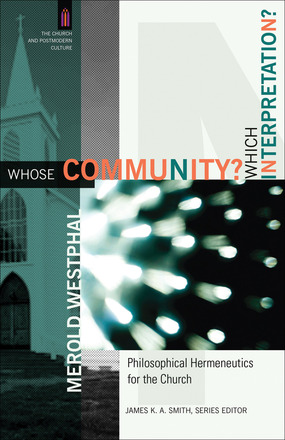
Merold Westphal: Whose Community? Which Interpretation?

 Merold Westphal, Whose Community? Which Interpretation?: Philosophical Hermeneutics for the Church, The Church and Postmodern Culture Series (Grand Rapids: Baker Academic, 2009) , 160 pages, ISBN 9780801031472.
At last! A reliable and accessible book on philosophical hermeneutics for pastors, seminarians, and Christians, who may know little about the philosophy of interpretation.
Merold Westphal is a distinguished professor of philosophy, postmodernism and ontological theology at Fordham University. In this book, he demonstrates that key lessons in the development of philosophical hermeneutics—from Frederick Schleiermacher to Hans-Georg Gadamer—can enrich Bible reading, whether studied professionally by a theologian, expounded orally by a church leader, or read devotionally by a Christian.
Underlying Westphal’s concise treatment is the argument that postmodern philosophical perspectives on hermeneutics (which some believed to be only a faddish ideology) can contribute to the churches’ quest for rightly reading and understanding Scripture. As the series editor James K.A. Smith introduces in the foreword, Westphal makes careful distinction between the “relativity of finitude” (recognizing that our interpretations are deeply affected to our finite and relative understandings) and “an absolute ‘anything goes’ relativism.”
Postmodern approaches to interpretation have led some to feel “hermeneutical despair” while the opposite extreme could be described as “hermeneutical arrogance,” those that believe pure truth can be received without mediation. Westphal’s nuanced treatment will help Christians navigate between such despair or arrogance, and because of that, Whose Community? Which Interpretation? “is a gift for the Church” (p.11).
Westphal explains there is a myth that goes like this: to read the Bible “plainly” is to read it correctly, but those that “interpret” the Bible read it incorrectly because their methods predispose them to a subjective bias. However, can a reflective reader really preserve the objectivity of the biblical message yet ignore the mediatory role and pre-understandings they brings to the text? In reality, because we are finite beings, we will not have infinite and total knowledge. Westphal shows that from Schleiermacher, a reader will approach texts with presuppositions, and often these assumptions are fed to us from our “hermeneutical circle.” We have to learn to hear the author, including their psychological state, and not just the subject. We have also to learn to see how the different context is dependent on the larger contexts. From Dilthey, we learn that rules help overcome some levels of subjectivity in our readings although many scholars remained critical about any supposed “universal validity of objective/scientific” methodology. From continental philosophers (like Heidegger, Riccoeur and Gadamer), we learn that, to a large extent we are all relativistic in our interpretations: we never interpret “out of nowhere” but from our respective “locations” (not limited geographically), and even at conversion, we read texts from a prior location of “somewhere” ideologically to another ideological position “somewhere else” (p.36). These locations are what philosopher Hans-Georg Gadamer calls, “our throwness – the immersion and formation of our consciousness and pre-understandings” (p.70) and “historically-effected-consciousness” (p.74), and in which as readers, we later introduce “a fusion of horizons” (p.107) into our readings, drawing from our respective traditions and backgrounds as well as the many other horizons that interface with our interpretation (ch. 6). I will return to Westphal’s review of Gadamer shortly. From Reformed philosopher Nicholas Wolterstorff’s reading of J. Austin’s speech-act theory, we learn that language is a performance subjected to moral and legal norms operating under certain circumstances, so while we may arrive at a fixed authorial meaning, we cannot necessarily conclude towards an authorial intent.
To arrest the “vertigo of relativity and its fears” (p.45), Westphal proceeds to review the position that right interpretation gives meaning of the text (known as objectivism), whereby the author determines the meaning and the text limits the scope of interpretation. However, contrary to this view, Westphal raises questions about the indeterminacy of meaning in various contexts, and argues that Hirsch’s approach opens the door for revoking authorial privilege. Michel Foucault and Jacques Derrida taught that, readers often “make meanings” beyond authors’ explicit articulations. Although drawing from the richness of continental philosophies, Westphal explains that a careful reader must not infer from “X is not responsible for Y” to mean that “X is not in any way responsible for Y”; which unfortunately is a fallacy committed by both atheists and biblical readers of the “I see plainly, you interpret” paradigm (p.58-59). As Westphal puts it, “‘the death of the absolute author’ is not ‘the death of the author’” and while authorial intent is important for deciphering the meaning of the writings, there is, as Gadamer rightly explains, a “productive aspect to interpretation” (p.62, 83). From Paul Riccoeur, we learn that interpretations involve authorial intent, understanding how texts came about, and seeking how the original audience understands the texts before we explore its significance for our contemporary time. As Wolfterstorff eloquently puts it, interpretation seeks to know what “someone says something to someone about something” (p.64). Beyond the aforementioned, our role as students of Scripture is also to ask, what is God saying to us through the texts today. The complexity of reading then is that the reader must remove any “pretensions of absolute knowledge” (p.66) and acknowledge when there may be more than one way to construe a text. Westphal is quick to explain though that to claim the above does not mean that all interpretations are valid (p.67). Throughout his treatment, he repeatedly draws out when a reader would do well to distinguish between recognizing the “relativity of [one’s] finitude” and the absolute-ness of a thoroughly-going relativism.
From Gadamer, Westphal also explains that because of the finite and spatial nature of our “historically-effected-consciousness” (p.74) that shapes our perspectives, we would be foolish to presume that we can stand in total objectivity at any one time, and/or all the time: in truth, we were located as finite beings in time and space, and even if we can somehow distance ourselves from our present and past time and space, we are never able to be totally objective as if we can stand outside the totality of time and space. As such, even if we can distance ourselves, the removal of prejudices is not entirely possible; we always read through some presumption and bias whether we have reflectively considered it or not. Likewise, standing within a tradition when a tradition reads another, no tradition can claim final, absolute and exhaustive authority (p.76, 85). Consequently, our interpretations will always be subjected to revision, and/or replacement (p.76). To claim that God speaks to us infallibly, implied in the paradigm that “I see plainly” whereas “others interpret,” is to make the fundamental mistake of an imaginary and unjustifiable hermeneutical truism and arrogance. We must then guard against “clinging to prejudice against prejudice” (p.77), which is the philosophical mistake of the Enlightenment project (ch. 7).
There is no cause for hermeneutical despair. As Westphal explains, the revelatory nature of the biblical text – God spoke and still speaks (p.148) – presupposes that readers come to the text to seek and obey its injunctions, and not to subordinate the text to a method or procedure of interpretation in order to prove the superiority of their readings of the text (p.85). Thus, because of this, we do not need to nor do we have to have guarantees regarding the correct interpretation all the time. Rather, we should be mindful of the essential role and purpose of reading the text in light of the abovementioned, as well as our situated relativity as a reader (p.86). The manner of interpreting Scripture then is to re-learn how we look at the complex structures of unity in diversity, of texts and worlds, and to pay attention to not just the different degrees of interpretations – wrong readings, right readings but poorly explained, as well as the superior interpretation (he calls it performances) (p.105). It entails recognizing the place of drawing from multiple translations, concretizing meanings through different applications in the many possible conversations this dialogical nature of truth quest can be recovered and produced in understanding the classic text (p.106, 109, 118). Westphal’s broad affirmation of an ecumenical reading is grounded in the posture of “hermeneutical humility” (p.143) in light of all of the abovementioned. Since the divine voice is also able to break through our prejudices, we must be ready to revise our human interpretations and conceptions which are never ultimate or absolute (p.153). From Levinas’ treatment of transcendence disclosing itself through the faces of the marginalized, suffering and oppressed, Westphal reminds readers of the often unconscious “oppressive” nature of a “hermeneutical arrogance” and therefore brings readers once again to recognize the various tensions in biblical interpretation, from philosophical perspectives.
Westphal also explains that the church’s reading of Scripture may be analogous to a Liberal-Communitarian conversation, which pays attention to the different currents left and right that finds some validity in a broad doctrine of the church. Perhaps here we see Westphal’s weakest link – though he shows familiarity with the various historical development in political ideology – it is too brief and vague for any reader to evaluate his assertion that the church operates best with the analogy of such a Rawlian Liberal-Communitarian approach (ch. 10).
I recommend reading the Bible with Whose Community? Which Interpretation? without reservations! Drawn from philosophical traditions, Westphal explains some fundamental fallacies in the reading of Scripture among others in only 156-pages. You will enjoy Scripture more, and you will no longer fear philosophical-hermeneutics, let alone Postmodernity; because Westphal explains these philosophical depths in accessible and plain English!
Reviewed by Timothy Lim Teck Ngern
Publisher’s page: http://bakerpublishinggroup.com/books/whose-community-which-interpretation/270460
Preview Whose Community? Whose Interpretation? books.google.com/books/about/Whose_Community_Which_Interpretation_The.html?id=CZd1NmvVrnQC