
Joseph Lee Dutko: The Pentecostal Gender Paradox
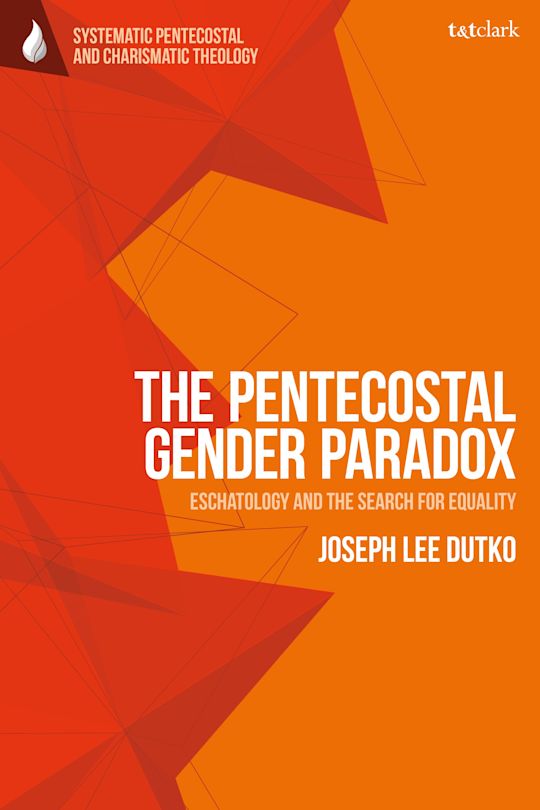 Joseph Lee Dutko, The Pentecostal Gender Paradox: Eschatology and the Search for Equality (London: T&T Clark, 2024), 297 pages.
“Women can be ordained and preach, but they are not permitted to teach theology.” These were the instructions I heard in a Pastoral Epistles class during my junior year at an Assemblies of God Bible college. I walked away from it confused and frustrated because I sensed a call to teach. As a female, I had heard that I was empowered by the Holy Spirit to minister. However, in that moment, I simultaneously heard both a message of empowerment and disempowerment. It is this paradox Joseph Dutko addresses in The Pentecostal Gender Paradox: Eschatology and the Search for Equality. In this well-researched, thoroughly Pentecostal publication, Dutko beckons Pentecostals to a live out today an equality as imagined in the eschaton—the time when God will be all in all (1 Cor 15:28).
As both a pastor and an academically-trained theologian, Dutko intersects Pentecostal history, eschatology, pneumatology, and biblical texts to form a solid foundation for a praxis of equality. By outward appearances, Dutko’s proposal may seem to some to be strictly theoretical, but it is not. It is a praxis, which, to quote theologian Ray Anderson, is “truth in action.” It is a living out today a biblical theological egalitarianism of the future. While Dutko’s Gender Paradox is academic, church leaders will appreciate how he offers specific ways (praxes) for churches to play with an expression of an eschatological egalitarianism. That is, he puts forth how we as Pentecostals may creatively live out a biblical equality between men and women that is based on our future in the new heaven and the new earth.
Pentecostals have contradictory words and practices in imparting both liberation to and restrictions on women within Pentecostal circles.
Dutko focuses on participation in the future by centering on transformation in the here and now.
Dutko explores the historical pentecostal movement to demonstrate that early Pentecostals (those from 1901-1920s) drew from eschatology to authorize women in ministry. Dutko analyzes women’s stories to see how women and men defended women’s recently discovered liberties. More specifically, he explores how an eschatological approach assisted in formulating early Pentecostals’ rationale concerning gender equality. At the beginning of the Pentecostal movement, early Pentecostal periodicals indicate that men upheld the new liberation of women in ministry, overriding previously held restrictions by drawing from eschatology. Dutko then underscores the stories of Maria Woodworth-Etter, Zelma Argue, and Aimee Semple McPherson in order to determine how they biblically justified their freedom in ministry. He perceives that these women mainly lived out their newfound freedom, but when they were called upon to defend it, they drew from eschatology.
When the Pentecostal movement shifted from a forward-looking to a restorative movement, the liberties of Pentecostal women faded.
Contrary to the restorative approach’s method of biblical interpretation, whose aim is to return to the New Testament church, Dutko draws from an eschatological lens when interpreting three essential biblical texts. By doing so, he seeks to create a unifying, egalitarian account of Scripture that mirrors early pentecostalism and contemporary Pentecostal scholarship. Dutko uses the following texts to serve as a guide for scriptural interpretation in relation to egalitarianism: Genesis 1—3, Galatians 3:28, and Acts 2:17-18, which are respectively entitled creation, the ministry of Jesus, and Pentecost. For Dutko, these are principal, egalitarian, interconnected, biblical texts that communicate the central narrative of Scripture: “creation, fall, redemption, and restoration” (132). Dutko contends that these texts have priority as they provide a model when confronted with other more culturally bound texts, such as 1 Corinthians 14:34-35 and 1 Timothy 2:11-15, which restrict women. His granting privilege to certain biblical texts over others is not unusual since what is clear in Scripture is frequently used to interpret ambiguous texts. That is to say, not every passage of Scripture is regarded equally in Christianity. Pentecostals normally treat Luke-Acts as more important, turning it into a hermeneutical guide when discussing Pentecostal issues and theology. With this in mind, some texts are declared more significant in relation to egalitarianism because they offer an obvious direction eschatologically—one of equality. For Dutko, these texts beckon Pentecostals to picture how they may take part “in eschatological realities” (142).
Participating in eschatological realities leads to a Pentecostal praxis of egalitarianism, liberating women to minister according to God’s call. Dutko puts forth a pre-enactment praxis model rather than a re-enactment one. The latter centers on copying the events of the past while also assuring that a repeat of said events will be genuine. The former, too, is orientated by the past, but it envisions the future and explores ways to live that out in the present. As such, the pre-enactment praxis model is connected to previous, current, and upcoming events. Dutko writes, “Pre-enactment is an exploratory rather than an explanatory model” (180). An example, offered by Dutko, is Sabbath-keeping. A pre-enactment praxis of Sabbath-keeping contains an open inquiry of conceptualizing and testing how to live out an eschatological rest today (exploratory). Re-enactment of Sabbath-keeping is less open and more rigid as it centers on living out a Jewish ritual of the past (explanatory).
Dutko’s Pentecostal eschatological-egalitarian praxis is different from applying a biblical text, which is a linear approach. According to Dutko, an eschatological-egalitarian praxis is a process that is dialectical (back-forth dialogue of opposing/supporting ideas), experiential, and experimental while being firmly grounded in the authority of Scripture. As a Pentecostal community imagines and participates today in the realities of the eschatological biblical texts, it is both experimenting and experiencing the future hope of the texts. As such, the biblical texts become more alive and real as the community perceives more fully the meaning of the text. In this way, the praxis (truth in action) is a continual exploration as the biblical interpretation of an eschatological text is tested and experienced. The more the community experiments with living out an eschatological-equalitarian biblical text, the more they understand the meaning of the text, which leads to increasingly living it out and understanding more, etc. Pre-enactment praxis is a transformative spiral of experimenting, experiencing, and understanding the realities of the eschatological-egalitarian biblical text.
While The Pentecostal Gender Paradox mainly centers on the USA and Canada, the question remains whether or not Dutko’s proposal transfers to other races, ethnicities, and cultures, a question Dutko also asks. If it does, what characteristics or elements does it embrace that are similar or different to a Western expression? One possible varying factor is the independent revivals around the world that were separate from the Azusa Street revival, such as in India and Korea. In this light, one must inquire if the experiences of early Pentecostals in Asia were similar or different from those in the Azusa Street revival while considering the possible ways to live out eschatological realities in non-Western contexts.
Dutko’s approach is thoroughly Pentecostal in that it mirrors early Pentecostalism; provides strong biblical support; involves reflections on a theology of the Holy Spirit; and stresses a praxis that participates right now with the Holy Spirit in Christ’s ministry in the world. As I reflect today on that undergraduate lecture in Pastoral Epistles, I am greatly encouraged and hopeful by Dutko’s liberating Pentecostal theological praxis of egalitarianism. It departs from a concentration on self-agency by orienting Pentecostals to participate in the movement of the Spirit toward the renewal of all creation. Thus, may it be said of Pentecostals that our beliefs about the eschaton direct our lives today, particularly in relation to egalitarianism.
Reviewed by Pam Engelbert
Publisher’s page: https://www.bloomsbury.com/us/pentecostal-gender-paradox-9780567713650/
Preview this book: https://books.google.com/books?id=y8DREAAAQBAJ

Category: Biblical Studies, Winter 2026

 Followers
 Fans
Fans