
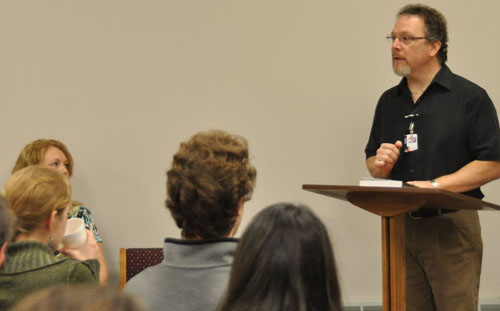
In Conversation with Andrew Schmutzer, Part 2

An interview with Andrew Schmutzer about The Long Journey Home: Understanding and Ministering to the Sexually Abused, and part 2 of his chapter, “A Theology of Sexuality and its Abuse: Creation, Evil, and the Relational Ecosystem” as appearing in Pneuma Review Fall 2013.
A Theology of Sexuality and its Abuse—Part 1 A Theology of Sexuality and its Abuse—Part 2
Note from the Editors: Beginning a conversation about sexual abuse is uncomfortable, but we feel strongly that this topic is something the church needs to address. We believe the testimonies of authentic recovery can help us embrace the pain of the hurting and make openings for God to bring healing.
Pneuma Review: You wrote, “Christian theology has historically separated culture from nature and nature from theology, which unfortunately has dichotomized the temporal from eternal, material from the spiritual, and so creation from redemption.” Please give us some examples of this.
Andrew Schmutzer:

My point here is to inform the reader of how common dualisms are in Western theology (e.g., body vs. soul, etc.). These polarities are more anesthetizing than energizing and this has had a devastating effect on a theology of personhood (what is called anthropology). Western Christianity as a whole has emphasized a highly individualized salvation. Eschatologically separated from creation and community, salvation, as it has traditionally been taught, has scorned the physical world and with it human embodied sexuality. In practice, it has been part of Christian pietism to associate sexuality with the “world, the flesh, and the devil,”—all bound to sinful humanity. Waiting for this world to just “burn up” and a better one to begin does not welcome people to live now. An isolated salvation has resulted in an isolated life, a simplistic human being, and a simplistic view of trauma.
An emphasis on a “deeper” spirituality has been code for ignoring the complexities of embodied life, on the one hand, and declaring “victory” over suffering, on the other hand. Along with a minimization of the physical realities of life, this world view can loom so large that there is little if any basis for physical and relational consequences of sin in relationships. When grace becomes perfectionistic, the raw pain of an abused teenager can be easily dismissed with reminders that “one day we’ll all shuck this physical container, anyway.” As a survivor, I’ve heard such statements as: “Just move on to victory,” “Just submit to the Holy Spirit,” “All things are new in Christ Jesus,” and others. Making such statements to a victim—especially from a non-survivor—actually rejects their pain, informs them they can’t be frustrated with God, and ignores the embodied realities of their suffering (e.g., dissociation, panic attacks, cutting, gastro-intestinal illnesses, etc.).
Abuse tears apart the wholeness of a person. Abuse does not merely objectify a person, it coldly approaches and latches on, hobbling its victim with complex wounds. As such, sexual abuse de-personalizes because it tears out pieces of the person that are intimately connected to the larger fullness of being. This violation does not extinguish life, it deadens life along a spectrum of security and terror, respect and shame—wholeness and brokenness.
Therapy for abuse victims helps reconnect the matrix of body, mind, and community. There is paradox in healing from sexual abuse: as more pieces are found and reattached, the pain actually increases, since there is more of the person to hurt now. Unless these pieces are reattached, healthy orientation to self, others, and God is stunted at best and remains twisted at worst.
Abusers act out from their own distorted theological anthropologies. It is hard to respect another’s body when one’s own sense of the physical and relational world is skewed. Again, here is where the victimizer and victim meet. Inadequately accountable to community, the victimizer can move easily from “my salvation” and “my Jesus” to the displaced notion of “my home” and “my sex life”—an ethical oxymoron. But an abridged view of personhood actually drives both. Intoxicated by their narcissism, the victimizer has already spurned accountability. This connection is important: in part, what allows the victimizer to victimize—lack of community intimacy—in turn, deprives the victim of the same.
How one views the human being determines how one will address the trauma of sexual abuse, the tenacity of evil, the role of counseling, the reality of depression, the relationship to addictions, the tendency of victims to abuse their own children, the complexity of PTSD (Post Traumatic Stress Disorder), the fear of the “crime scene,” and the use of medication. In other words, dualistic thinking goes to dangerous extremes when it isolates the spirit from the body, romanticizes heaven, minimizes social ethics, and excludes the broader creation from God’s redemptive plan (e.g., escapist theologies). In the end, these dualisms actually shred the social-spiritual-physical bindings of people.
PR: What are some ways you have seen churches acknowledge the sexually abused, and how has this given an opening for survivors to lay aside shame and begin to heal?
Andrew Schmutzer:
In truth, I’ve not seen churches do much at all. As I’ve said before, peanut allergies are addressed with greater consistency and honesty. The chapter entitled “Healing the Wounded Heart through Ritual and Liturgy,” in The Long Journey Home (pp. 293-313), may be the best discussion in print of incorporating creative ideas for survivors’ healing. Don’t think merely in terms of what your style or worship tradition can handle. The goal of healing the abused must be willing to work outside the constraints of any given tradition. It’s about the needs of the sexually broken. If we took this more seriously, maybe more abused would still be in the church—about 20% of a congregation! Try something new for the sake of the abused, the sick and broken that Jesus came to heal.
I love our Lord’s church and I have a deep burden to see the ancient sin of sexual abuse normalized in teaching, preaching, and healing services of all kinds. Sadly, there’s very little I’ve witnessed from churches that are trying to proactively address abuse. For this reason, I’ve written extensively about ideas, needs, and opportunities churches have to creatively minister to their sexually broken. Let me recap a few ideas.
- For education: host a conference on sexual abuse working with several local churches. Bring in a keynote speaker who can powerfully address sexual abuse. In addition, include several other counselors, social workers, and support group leaders from the community who regularly work with the abused. They can offer break out sessions to tackle particular issues. Invite pastors, elders, youth group leaders, and survivors to come. Let a drama team act out Jesus’ interaction with the woman caught in adultery (John 8:1-11) or Joseph constantly turning down the sexual offers of Potiphar’s wife (Genesis 39) or waking up Jesus in the boat (Mark 4:35-41)—something many survivors have tried to do! Sell books, offer literature, highlight community services, and quality examples of church policy to address both survivors and offenders. Churches desperately need their leaders to cast a vision for this.
- For worship: start incorporating meaningful, non-triumphalistic elements in worship designed to acknowledge and enact corporate grief on behalf of the sexually broken. Keep in mind, most victims have suffered in silence their entire lives, while others around them have been singing: “God you are healer…” Please don’t ask them to shout in praise until you’ve held them while they weep. Use testimonies, songs about how our God also weeps for his children, written prayers of survivors struggling to find this protective God. This is why I wrote prayers for survivors in The Long Journey Home (pp. 375-401; see example below). Unfortunately, contemporary worship is no longer educational, but imagine hearing a testimony from a missionary in Cambodia or India who works with abused children. Hebrews speaks of praying “as though you yourselves were also [in chains].” We need more of this empathetic involvement from people. Dedicate April, national abuse and sexual violence month, to intensive naming of abuse and starting support groups for female and male victims. Most churches have one for “divorce care” but never one for male survivors and 1 in 6 men are abused. Include survivors in healing services, with responsive readings, prayers circles, Bible readings, anointing with oil, and white flowers distributed to those who want one.
- For support: along with a standard support group for survivors, offer even a modest library of quality literature on abuse from a Christian world view. There are books that speak to survivors and leaders, from basic to intermediate, and advanced levels. Small cards identifying counselors, pastors, and support ministries can be offered alongside other church literature. Church leadership should have some wounded leaders, those who understand the painful code words (e.g., “someone took advantage of me”) that survivors use. Wounded leaders aren’t threatened by victims’ trust issues, because they see behind the angry outbursts to a child frozen in fear. For a discussion of some myths that must be broken in order to adequately shepherd survivors, see my brief article at: http://www.efcatoday.org/site/article/shepherding-survivors-of-sexual-abuse
PR: You said that there is a “need for collective restitution and healing on an international and inter-faith scale.” What would the mechanism be for a local church to interact in such a global endeavor? Is such coordination even possible?
Andrew Schmutzer:
I grew up under Apartheid (South Africa), and people didn’t think that would come down in my generation. I suppose the way voting rights were withheld from women and African-Americans in the US is a shocking change, given the entrenched ideologies that created the problem to begin with. That said, I’m profoundly saddened that addressing sexual abuse in our churches lags far behind the fall of Apartheid and Women’s Suffrage. I no longer ask if something is possible. Advocacy for the sexually abused is not a business venture. Instead, being an advocate means I blaze trails where they are needed, not where they are easy.
Like Bishop Desmond Tutu, who accomplished stunning work in the Faith and Reconciliation Commission, I hunger for genuine dialogue of a more ecumenical type for the sake of the abused in every church, ethnicity, gender, tradition, and country. My training is in theology not marketing, but the era of social media, savvy networking, and global concern over sex trafficking tells me that more can be done than presently is. In short, we need international collaboration and dialogue among faith communities for a deeper engagement of naming, confessing, repenting, forgiving, and reparation. By reparation, I refer to even the symbolic currency of apologies given by churches, denominations, key religious leaders, and international forums. This is not about money; it’s about the honesty of collective grief. I’m more than happy to join hands with all kinds of faith expressions for the purpose of collaborative ethics. The Gospel is also about ethics!
I’m not asking if it’s simple or possible; I’m seeking holistic healing that the “household of faith” (Gal. 6:10) should be pioneering for its own people. Those who have a voice are obligated to speak for those who don’t—silence is not an option for me.
On This Day of Mothers & Fathers
(For Mothers’ or Fathers’ Day)
On this day … grief is mixed with smiles,
healing with loss,
safety with haunting memories … is there a rose left for us? Too many memories of loud insults and silent wounds,
Too much confusion over what healing really means,
Too much grief unheard, unheeded, unhealed…especially on this day!
For parents who did it right—we are glad.
for happy sons and daughters, though we cannot identify
with either honest parents
or well-adjusted teens. Give these parents flowers for all the fragrant memories
that they’ve planted in their children’s hearts. But what beauty remains
for the deflowered on Father’s Day? What sweet fragrance lingers
on hypocritical roses of Mother’s Day?
On this day… what should we give to mothers and fathers
who stole so much and admitted so little? We do have: Promises for our little ones ~ God help us do right by them!
Smiles and some laughter for new families ~ may new rituals bury the old!
Letters to be read one day, when we’re gone ~ let them grieve with insight!
Tears for the ground that has felt them before ~ let new memories grow there!
But flowers!
Yes, some flowers for mothers and fathers…
not our own, but those who have held us
and taught us to hold.
On this day, we have warm tears
for our broken mothers and fathers.
But to special friends who shed the Samaritan’s tear…
for them, we have flowers.
A testimony offered in the name of the One
Who: created,
wept,
and was buried in a garden.
Jesus Christ, our sweet Flower of Glory,
The “Rose of Sharon” is ours,
flowering most fragrantly in broken hearts.
AJS, 5/8/09 Amen.
PR: Pragmatically speaking, how would you hope readers would respond to this chapter?
Andrew Schmutzer:
I would like to see knowledge increase, policies change, leaders become more vulnerable. I want people to understand that working with the sexually abused is about care, not cure. Most abused will live with serious struggles for the rest of their lives—the non-abused need to accept this as much as the abused. We live “South of Eden” now, and the prevalence of sexual abuse is a good indicator of this. Living within the Creator’s relational ecosystem also means that there are contexts of healing: personal, communal, and theological. For example, the theology of the image of God means we must affirm the embodied reality of life; healing must encompass all of these realms, physical, social, and spiritual.
Understanding why the abused struggle so much with a God who “never stepped in” means we must be more creative in how we address survivors in the context of worship. Leaders must understand how sexual abuse can colonize itself in families, lasting generations. Praying Psalm 51 doesn’t heal years of toxic evil practice. Understanding the relational ecosystem also means we are able to detect ways the evil of sexual abuse has vandalized entire families, communities, and congregations. I want people to understand how some kinds of evil have an after-life, polluting relational layers far removed from the original act (if it can even be found!). All these realms of relationship—with God, family, and self—can be disoriented by sexual abuse. Maybe it’s time to hear about these struggles first-hand in some testimonies.
Abuse care has been slow to come of age. I pray that the church I love will live out its concern for social justice and reach out to the abused walking among them. It’s time to break the sacred silence for “the least of these.”
PR












Another excellent read from Dr. Schmutzer. Let's hope his students follow up with more discussion under this article.
Another excellent read from Dr. Schmutzer. Let’s hope his students follow up with more discussion under this article.
is there a “non-abused” class of people? Or are there only deniers of being abused? Only ones getting help are those admitting to being sexually abused.