Knowing Creation: Perspectives from Theology, Philosophy, and Science, reviewed by Stephen Vantassel

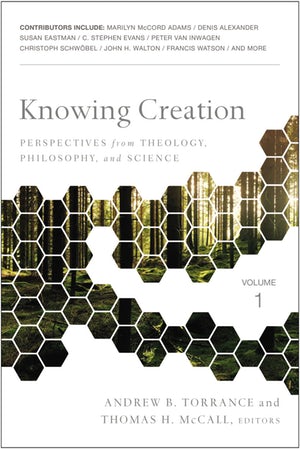
 Andrew B. Torrance and Thomas H. McCall, eds., Knowing Creation: Perspectives from Theology, Philosophy, and Science, Volume 1 (Grand Rapids, MI: Zondervan, 2018), 352 pages, ISBN 9780310536130.
In recent decades, the long struggle between science and theology has intensified, forcing Christian theologians to increase their attention on the doctrine of creation. The challenge facing theologians was is how to correlate and contextualize biblical teaching concerning creation with the findings of contemporary science. The effort is difficult because of the diversity and complexity of the issues which include how we got here, the relationship between revelation and reason, free-will and providence, and biblical teaching about nature. Knowing Creation (vol 1.) addresses these subjects through 16 articles by scholars from prestigious schools who self-identify as Christian. The editors explicitly sought to make the book interdisciplinary, arguing that too often academics become siloed in their field (p.18).
The book is organized into four sections each containing four articles: Theological Perspectives, Biblical and Historical Perspectives, Philosophical Perspectives and Scientific Perspectives. While the editors wisely decided to organize the articles by theme or emphasis, readers should understand that some of the categorizations were arbitrary. For example, Mark Harris’ article, “’The Trees of the Field Shall Clap Their Hands’ (Isaiah 55:12): What Does It Mean to Say That a Tree Praises God?” is placed in the Scientific Perspectives section but could have easily been placed in the Biblical and Historical Perspectives.
Given the diversity of topics covered in this text, an integrated review is impossible. So rather than write on all 16 articles, attention will be placed on a few select papers taken from each of the sections.
Section 1 Theological Perspectives
Simon Oliver’s article, “Every Good Gift is from Above” discusses the relationship between culture and nature and how the often-touted dichotomy between nature and culture is problematic (p. 31). In this, Oliver is spot on. The idea that nature is to be understood as non-human assumes an improper understanding of both nature and humanity. In short, it is a false dualism. Oliver contends that viewing creation as a gift from God helps overcome this dualism. He explains this by employing Marcel Mauss’ conception of gifts and giving. Oliver concludes by arguing that food unites culture and nature. He then continues to tease out the implications of the aforementioned premise by drawing on biblical narratives showing how food is strongly associated with reconciliation and communion (i.e. fellowship). In this way, food is both a gift and an offering. Oliver concludes by drawing attention to how food production is tied to much of the environmental problems of our day. Recognizing the interplay between food and culture highlights the importance of creation in our lives and in the biblical narrative.
Oliver’s insights are rather abstract and tend to arrive at theological conclusions that are at times a bit tendentious. Nevertheless, his ideas are stimulating and worthy of engagement.
Christoph Schwobel’s “’We are all God’s Vocabulary’: The Idea of Creation as a Speech-Act of the Trinitarian God and Its Significance for Dialogue Between Theology and Sciences,” discusses the nature of metaphors and the role they play in our apprehension of reality. He contends that it was a shift in metaphor use about creation from Augustine’s God as author of nature and scripture to nature being viewed mechanistically as a clock led to the ultimate split between being and meaning. Schwobel suggests that understanding the Trinity combined with Luther’s notion of God’s creative act in speech, offers a way to reconnect being and meaning again.
Schwobel’s thoughts were enlightening. But I wondered whether the problem of integrating being and meaning rested with using the correct metaphor or whether the issue was that scientists by rejecting the creator needed a new metaphor to replace the previous one they rejected.
Section 2 Biblical and Historical Perspectives
John H. Walton’s article, “Origins in Genesis: Claims of an Ancient Text in a Modern Scientific World,” summarizes his ideas found in his published books. Walton argues that Genesis 1 and 2 cannot be used to address the issue of earth’s origins because the Israelites lacked the categories that distinguished natural versus supernatural means of action. Likewise, ancient cosmologies focused less on material origins and more on identity and role. Thus, the contemporary interest concerning the identity of the first humans is not one that can be answered by such an ancient text that does not contain the same categories.
While the discussion of sacred space enriches our reading of Genesis, Walton’s overemphasis on the bible’s human authorship neglects the divine input artificially forcing him to give ground to contemporary scientific views. I found it odd that Walton used New Testament authors to support his views but ignored passages that conflicted with those same views. Walton is correct to raise his questions but his conclusion needed a bit more evidence for this reader to arrive at his conclusion.
Section 3 Philosophical Perspectives
Robert C. Koons takes readers on an exploration of intellectual paradigms in his article, “Knowing Nature: Aristotle, God and the Quantum.” Koons argues that Aristotelean metaphysics was conquered by the microphysicalists of the 14th century and those that came after. The result of this paradigm shift was the loss of purpose and final and formal causes of Aristotelean philosophy. Koons explains that quantum physics has raised serious questions about the validity of microphysicalism. Researchers are showing that the whole can affect the part and that the quest for a single unified theory of reality may need to give way to a structural theory that allows for the co-existence of various theories dependent on the scale under study.
The article is a fascinating, yet difficult read. I suspect that scientists looking to merge social and hard sciences would do well to consult this article.
Section 4 Scientific Perspectives
For the last article, I chose Mark Harris’ piece on Isaiah 55:12, mentioned above, because it engages an important issue on the interpretation of scripture, our understanding of metaphors. Harris takes up the question of how scriptural teaching about creation’s worship of God is to be understood. He begins by showing that a purely personification interpretation of the passages fails to account for all the evidence. He argued that to treat nature naturalistically without doing the same for humans is inconsistent. Interestingly, he does not jettison the personification theory entirely. Rather it should be considered alongside of Fretheim’s relational view, Horrell’s eschatological view and Bauckham’s being themselves view.
I found the paper intriguing. However, I wonder if he considered how recognizing the ontological distinction between humans and the rest of creation impacts his view. It seems to me that his very approach assumes a flattening of the distinction between humans and the rest of creation. In addition, he did not address Christ’s statement that the rocks would cry out if the people did not (Luke 19:40). Does this mean that the rocks were not praising God at that moment or that they would do so audibly for all to hear? I found it strange that Harris’ more literal reading flies in the face of other writers who contend that Genesis 1-2 should not be read literally or more accurately, plainly.
Summary
Readers should understand that there is no unifying vision for the doctrine creation in this book. Nevertheless, for those interested in looking at some of the key debates in different ways, this book should be engaged.
Reviewed by Stephen M. Vantassel
Publisher’s page: https://www.zondervan.com/9780310536130/knowing-creation/
Preview Knowing Creation, Vol. 1: https://books.google.com/books?id=0YEoDwAAQBAJ