
John H Walton and J Harvey Walton: Demons and Spirits in Biblical Theology
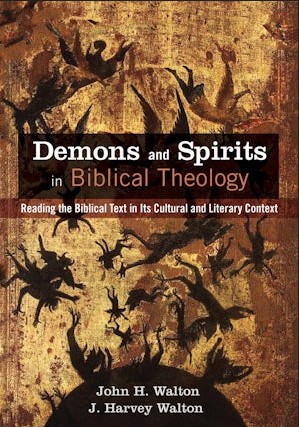 John H. Walton and J. Harvey Walton, Demons and Spirits in Biblical Theology: Reading the Biblical Text in Its Cultural and Literary Context (Eugene, OR: Cascade Books, 2019), 348 pages, ISBN 9781625648259.
John H. Walton, professor of Old Testament at Wheaton College (at the time of publication), teams with his son J. Harvey Walton to address the contested area in contemporary biblical interpretation regarding the nature and activity of demons and spirits in Scripture. Their central thesis challenges dominant spiritual warfare paradigms by arguing that the biblical authors were less concerned with ontological realities of the spirit world than with communicating theological truths through the cognitive environment of the ancient Near East. This approach, consistent with Walton’s broader hermeneutical project evident in works like The Lost World of Genesis One, prioritizes understanding Scripture within its original cultural and literary contexts rather than imposing modern systematic categories onto the text.
The Waltons organize their study around three primary sections: Old Testament perspectives, New Testament developments, and theological synthesis. Throughout, they maintain that biblical demonology must be understood functionally rather than ontologically—that is, Scripture’s purpose is not to provide information about the nature of demons but to communicate theological truths about God’s sovereignty and humanity’s relationship to the divine.
Scripture’s purpose is not to provide information about the nature of demons but to communicate theological truths about God’s sovereignty and humanity’s relationship to the divine.
The Waltons contend that the Satan of Job and Zechariah functions as a member of the divine council—“the adversary” who serves as prosecuting attorney in the heavenly court—rather than as God’s cosmic nemesis.
Turning to the New Testament, the Waltons acknowledge a more developed demonology but maintain their functional hermeneutic. They argue that Jesus’ exorcisms and confrontations with unclean spirits address the fundamental problem of human alienation from God rather than engaging in cosmic territorial warfare. Demon possession, in their reading, serves as “living metaphor” for humanity’s captivity to sin and the powers of disorder. When Jesus casts out demons, he demonstrates divine authority over chaos and previews the restoration of creation rather than engaging in strategic spiritual combat. The Gerasene demoniac (Mark 5:1-20), for example, illustrates Israel’s uncleanness and alienation, with the exorcism symbolizing restoration to community and covenant relationship.
The Waltons argue that Jesus’ exorcisms and confrontations with unclean spirits address the fundamental problem of human alienation from God rather than engaging in cosmic territorial warfare.
The Waltons make several valuable contributions to biblical theology. Their insistence on reading Scripture within its ancient cognitive environment prevents anachronistic interpretations that force modern categories onto ancient texts. Their functional approach helpfully refocuses attention from speculation about demonic ontology toward the theological purposes of biblical authors. Additionally, their critique of simplistic spiritual warfare models that lack clear biblical warrant serves as a necessary corrective to some excesses in popular-level demonology.
For the Waltons, the Christian’s warfare is ethical and missional rather than ritualistic or confrontational toward spirit beings.
While the theological significance of Jesus’ exorcisms certainly points to broader restoration themes, the Gospel accounts present these as real encounters with personal beings causing genuine human suffering.
Furthermore, the book’s dismissal of territorial spirits and strategic spiritual warfare may overreach. While excesses certainly exist in much spiritual warfare literature, passages like Daniel 10:13-21, which describe “princes” associated with kingdoms, suggest some idea of a territorial dimension to spiritual conflict, even if not in the manner popular spiritual warfare models propose. The Waltons’ eagerness to avoid contemporary excess may lead to underreading the biblical data.
While the book rightly cautions against unbiblical spiritual warfare practices, it may inadvertently dismiss legitimate aspects of charismatic praxis rooted in biblical precedent.
While avoiding naive acceptance of every cultural interpretation of spiritual phenomena, biblical theology should consider taking into account the worldwide church’s experience.
Demons and Spirits in Biblical Theology offers a provocative and carefully argued challenge to dominant evangelical demonology. The Waltons succeed in demonstrating that much contemporary spiritual warfare theology lacks a clear biblical foundation and that Scripture’s primary concern is theological rather than providing information about the spirit world. Their work serves as an important corrective and will benefit readers by fostering more careful biblical interpretation. Pentecostals and Charismatics would do well to read carefully this contribution to the ongoing conversation. It would serve far better than nearly everything that gets published in the popular marketplace (in articles, books, YouTube, etc.) by Pentecostals and Charismatics on the subject.
Nevertheless, the book’s strengths may be undermined by an overly reductive functional hermeneutic that seems to throw out ontological reality with its methodological bathwater. A more nuanced approach would affirm both the theological purposes of demonic narratives and the personal reality of spiritual beings, recognizing that ancient authors could simultaneously pursue rhetorical goals and describe genuine encounters. For Pentecostal and charismatic readers especially, the Waltons provide valuable cautions but may not adequately account for biblical precedent and experiential dimensions of deliverance ministry that have characterized these movements. The book makes an important contribution to the conversation but should be read as one voice in an ongoing discussion rather than as a definitive resolution to complex questions of biblical demonology.
As a further note, this book offers specific counterpoints throughout to the works of a number of influential scholars on the topic, including the late Michael Heiser. Heiser is well known for his proposed biblical theology of demons, angels, and “the gods” and what has been widely disseminated in his numerous popular publications, most notably his best-selling 2015 book The Unseen Realm (just updated and expanded posthumously in 2025). The Waltons have taken great care to address many of the issues which Heiser has popularized (having written extensively in academic forms as well) for his theology of the gods (e.g., divine council, sons of God, etc). It is with this in mind that it would be recommended that those who have read Heiser should also read this work by the Waltons, as offering the most cogent counterpoints to date.
Reviewed by Rick Wadholm Jr
Publisher’s page: https://wipfandstock.com/9781625648259/demons-and-spirits-in-biblical-theology/
Preview this book: https://books.google.com/books?id=WvGaDwAAQBAJ

Category: Biblical Studies, Winter 2026

 Followers
 Fans
Fans