
Josiah Baker: A Visible Unity
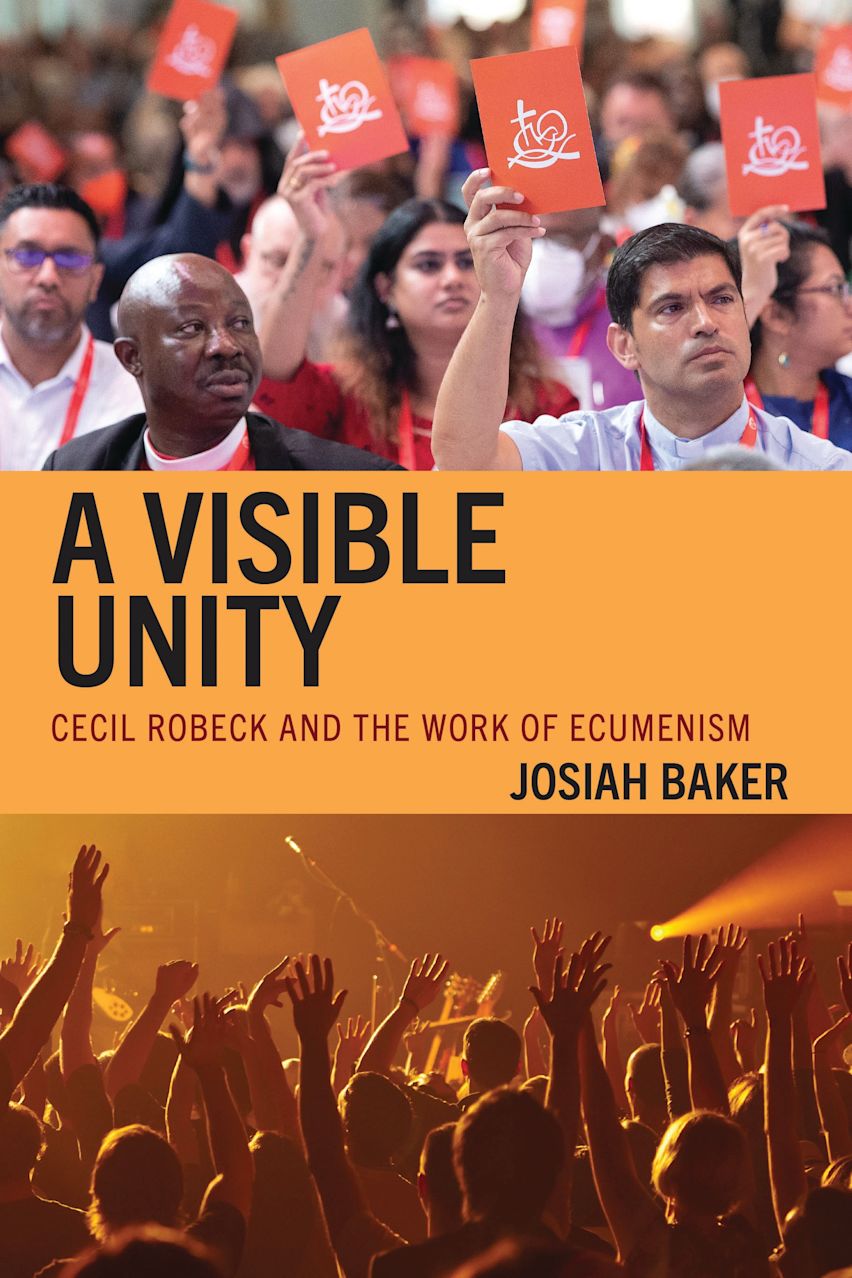 Josiah Baker, A Visible Unity: Cecil Robeck and the Work of Ecumenism (Lanham: Fortress Academic, 2024), 278 pages, ISBN 9781978717206.
A Visible Unity: Cecil Robeck and the Work of Ecumenism is a revised version of Josiah Baker’s dissertation, written under the supervision of Veli-Matti Kärkkäinen at Fuller Theological Seminary’s Center for Advanced Theological Studies. In this book, Baker argues that methods of ecumenical work express a shared ecclesiology among churches, and that as these methods evolve, the ecclesiologies of churches working together converge. To support his thesis, Baker traces the thought and contributions of Pentecostal historian and ecumenist Cecil “Mel” Robeck throughout his years of involvement in the ecumenical movement, demonstrating how specific ecumenical methodologies have led to ecclesiological convergence among divergent groups. This is a novel approach in that Baker chooses a single person who participates in multiple ecumenical initiatives as his locus of inquiry, rather than analyzing multiple persons or ideas related to a single initiative (9). Additionally, Baker’s choice of a Pentecostal voice confronts prejudices within the field of ecumenics that have excluded, dismissed, or marginalized Pentecostals, thereby allowing Robeck’s contributions to interrogate the presuppositions that have led to such a position. One of Baker’s stated goals for his book is to “canonize Robeck as one of the most influential leaders of the ecumenical movement as it entered its second century” (xi).
Baker’s choice of a Pentecostal voice confronts prejudices within the field of ecumenics that have excluded, dismissed, or marginalized Pentecostals.
The chapters draw on Robeck’s publications, personal interviews with the author, and his documented participation in ecumenical initiatives. Each chapter, from chapter 2 on, focuses on a particular ecumenical methodology. Methods include reconciling memories, conciliarity, bilateral dialogue, spiritual ecumenism, and Christian forums. In chapter 1, Baker divides Robeck’s ecclesiology into three fundamental dimensions: (1) the church as a divine initiative with God as the source of its unity and power to pursue unity, (2) the church as a historical community that inherits Tradition but is also subject to social forces, and (3) the church as the people of God that cannot exist apart from all its members (28). This ecclesiological framework informs Robeck’s thought and participation, which Baker analyzes in the subsequent chapters. Chapter 2 considers how Robeck’s ecclesiology comes to bear in his work on the Azusa Street Revival, the topic for which he is most widely recognized. Such work reflects hopes of achieving racial reconciliation through the reconciliation of shared memories, enabling racially divided churches to see themselves as part of the same story and community.
Chapter 3, on conciliarity, recognizes Robeck’s role in expanding the World Council of Churches (WCC) through his participation in various assemblies and consultations as a Pentecostal. Baker argues that the methodological shift in how the WCC pursues relations with Pentecostals directly resulted from Robeck’s work as co-chair of the Joint Consultative Group at the Harare Assembly in 1998 (100–101). Bilateral Dialogue is the subject of Chapter 4. This method creates opportunities for divergent churches to discuss issues that divide them as equals, converging in their ecclesiologies around elements of a common Tradition. Examples come from Robeck’s involvement in the Catholic-Pentecostal, Reformed-Pentecostal, and Lutheran-Pentecostal dialogues.
In Chapter 5, Baker leverages Robeck’s Pentecostal identity and Patristics scholarship to understand his affinity with spiritual ecumenism. This method, which relies on shared spiritual practices, creates a bridge between Pentecostalism and other confessions, as Pentecostals also make claims of apostolicity based on the practice of charismatic gifts, not only in the New Testament but also in the Patristic period. Finally, Chapter 6 explores one of the newest ecumenical methodologies: Christian forums. Baker acknowledges Robeck’s central role in pioneering this methodology through the Global Christian Forum (GCF). The GCF was created as a common space for dialogue outside of existing church or ecumenical bodies, with at least half of the participants coming from non-WCC member churches. Informed by his Pentecostal heritage, Robeck proposed incorporating testimonies into the form. Although initially rejected, the GCF eventually adopted the practice. Baker finds that ecclesiological convergence in Christian forums occurs through testimonies, as the sharing of stories fosters recognition of the Christian other as a fellow believer.
A Visible Unity is excellently written and remarkably well-organized. Baker is meticulous in the way he structures each chapter and section, reinforcing his thesis at each seam of his argument. The result is a coherent and easy-to-follow presentation. The Introduction will be difficult for readers new to ecumenics due to its theoretical density. However, this is to be expected from a project that began as a dissertation. With many important definitions and distinctions, non-specialists will need to slow their pace before continuing to Chapter 1. After the Introduction, though, readers will notice that Baker’s prose lightens up considerably.
This is a novel contribution that centers the work of a Pentecostal ecumenist, a label some might consider a paradox. Although Baker does well to acknowledge this tension, he could have commented on additional reasons Pentecostals are averse to ecumenism, such as suspicions rooted in premillennial dispensational interpretations of apocalyptic passages in the Bible. This added background would not only help non-Pentecostal readers better understand prevalent Pentecostal attitudes toward ecumenism, but it would also help eschew broad-brushed assumptions about Pentecostals and their eschatology by showing that Robeck, though unabashedly classical Pentecostal, does not share those same suspicions. Still, the portrait Baker paints of Robeck sufficiently illuminates and nuances ecumenical and Pentecostal discourse. I recommend A Visible Unity to seminarians and specialists who are interested in ecumenics, Pentecostal studies, systematic theology, and missiology.
Reviewed by Jacob A. Palma
Publisher page: https://www.bloomsbury.com/us/visible-unity-9781978717206/
Discover more from Mel Robeck at PneumaReview.com


 Followers
 Fans
Fans