In this book, Daniel Castelo’s main goal is to show how Pentecostalism “is decisively not a Protestant tradition generally” and “not part of contemporary evangelicalism particularly” (p. xiii). He moreover argues that pentecostal identity, spiritualty, and theological development are diminished when these foci are largely subsumed under Evangelicalism (p. xiv). He thus suggests that Pentecostalism “is best framed as a modern instantiation of the mystical stream of Christianity” (pp. xv-vi). Hence, “Pentecostalism is best understood as a mystical tradition of the church catholic” (p. xvi). Castelo thus argues that rather than immediately looking to contemporary Evangelicalism, Pentecostals can find far more congruent resources for articulating their identity, spirituality, and theology, in the historical Christian mystical tradition. In the Postscript, Castelo well summarises his purpose for this book: “Its aim has been to facilitate a theological exercise of rethinking Pentecostalism in light of mystical categories for the sake of deepening the connections of this movement within wider Christianity and also as a way of differentiating it from forms of reasoning typically associated with American evangelicalism” (p. 177).
Daniel Castelo
Besides the Introduction and Postscript, the book comprises five chapters. By framing the book’s thrust “within the domains of theological method and epistemology” (p. 1), in Chapter One (“The Challenge of Method”) Castelo substantiates his aims by demonstrating their resonance with past and ongoing pentecostal scholarship that has conceived Pentecostalism as a “spirituality” (pp. 1-6). Castelo devotes Chapter Two (“A Mystical Tradition?”) to identifying thematic aspects of the historic Christian mystical tradition which he believes are most congruent to pentecostal experience and spirituality. Here he argues that convergence can be seen between the pentecostal stress on “encountering God” as the aim of their liturgical practices (pp. 80-83) and the historic mystical stress on movement towards “union” with God (pp. 44, 55-57, 80-82). In Chapter 3 (“The Epistemological Form of Evangelical Theology”), Castelo argues the incongruence of contemporary Evangelicalism’s theological methodological approaches as a ready resource for pentecostal theological method, insofar that Evangelicalism continues its epistemological embedding within its fundamentalist-foundationalist heritage (p. 125).
“Pentecostalism is best understood as a mystical tradition.”
In chapter 4 (“Expanding the Pentecostal Understanding of Spirit-Baptism”), Castelo further explores how pentecostal experience and contemporary theological developments demonstrate deep resonance with historical mystical themes, and hence, how the mystical tradition provides Pentecostals conceptual and theological categories for best articulating their spirituality, particularly in relation to their understanding and experience of Spirit baptism (pp. 126-129). Finally, in Chapter 5 (“The Spirit-Baptized Life”) Castelo brings current pentecostal scholarship into conversation with notable figures representing the ancient mystical tradition. He does this to suggest practical ways on how retrieving Christian mystical themes can address common problems in Pentecostalism and also best express genuine pentecostal themes (p. 158).
It should be seen that in many ways, Castelo’s functions as a follow-up to themes and aims earlier pursued by Simon Chan in his book, Pentecostal Theology and the Christian Spiritual Tradition (Sheffield, 2000). Castelo in fact devotes a section to Chan’s earlier work (pp. 154-157). What primarily differentiates Castelo’s book from Chan’s earlier work however, is the greater analytical depth he gives towards explicating incongruence between pentecostal and contemporary evangelical (particularly North American) epistemological and theological-methodologies. Unfortunately, on this topic (chapter 3), his argumentation is quite dense and seemingly over repetitive.
Pentecostals are more than merely Evangelicals who speak in tongues.
I should provide some critique on how Castelo primarily nuances the negative (apophatic) theological themes of the Christian mystical tradition. Negative theology stresses human cognitive and linguistic limitations towards theological articulation. Granted, as Castelo argues, there are facets of negative theology very applicable towards expressing pentecostal spirituality, especially with reference to tongues-speech, and the trans-rational orientation of pentecostal spirituality. But I feel that the negative theology themes that Castelo has stressed, moves too far towards abstract, non-embodied reflection, which is precisely one of the things that makes the practice of theological reflection ill-fitted for many non-scholarly Pentecostals. He could have rectified this simply by more substantially surveying other aspects of the Christian mystical tradition, which I believe would provide a far better resonance with grassroots Pentecostals, thus better establishing the congruence between the two traditions. These would include bridal mysticism motifs, the missiological notions of mystical “union” language, and recent ecumenical work towards establishing the broader presence of “union” (“in Christ”) theology themes (a major theme in the mystical tradition) across Christian traditions, including Pentecostalism. To Castelo’s credit, he does suggest that the Three Ways narrative of the salvation journey (purgative, illuminative, and unitive ways) is a helpful scheme for articulating pentecostal notions of life formation (pp. 77-82). Finally, also helpful would be to ground the term “mystical,” as some approaches do, to the New Testament term “mystery,” thereby strengthening the missiological meaning to Christian mysticism.
Does abstract theological reflection fit pentecostalism? Does the Christian mystical tradition fit better?
Fortunately, the argumentative density I earlier alluded to, gives way to a very pleasant read in the last two chapters. Castelo’s final chapter (“The Spirit-Baptized Life”) helpfully suggests practical ways on how retrieving Christian mystical themes can address problems commonly identified with pentecostal spirituality, and conversely, better clarify those features of pentecostal spiritualty at its best. In all this, Castelo approaches the pentecostal chief metaphor of Spirit baptism not just as a one-time event, but better, as a category descriptive of the whole Christian life and journey. He then outlines how three Christian mystical themes would negotiate these aims: 1. Christian salvation as an upward ascending journey towards union with God (“Sweet Journey from Glory to Glory”); 2. Acknowledging seasons of adversity/”experiences of defeat”/desolation as divinely structured into the upward ascent towards union (“Steadfastness in the Midst of Spiritual Aridity”); and 3. Recognising that not everything in this upward ascent can or even should be readily understood (“Ignorance as a Dynamic of Grace”).
Spirit baptism is not just as a one-time event, and is better understood as a description of the whole Christian life and journey.
Notwithstanding the concerns I have raised, I therefore highly commend Castelo’s work as a valuable help towards demonstrating the ecumenical roots and resonance of pentecostal spirituality with the broader Church Catholic, rather than simply as “Evangelicals who speak in tongues.” He moreover provides practical suggestions towards retrieving historical mystical themes for better articulating pentecostal experience. Hence, Castelo provides apt warrant to fellow Pentecostals, to look beyond North American Evangelicalism for understanding who they are, and how they may best express their spirituality as a unique Christian tradition. More specifically, Castelo’s work should encourage Pentecostals to look towards Roman Catholicism, Eastern Orthodoxy, and Anglicism for apt theological resources. For we can and should do so, insofar as these traditions provide us open doorways into the historic Christian mystical tradition that in so many ways, better mirrors our pentecostal experience and spirituality.
Monte Lee Rice is a Pentecostal minister based in Singapore who served in churches and Bible colleges as a pastor, church planting director, and theological educator. He has ministered within some 15 nations in Southeast Asia and Africa, and graduated from Asia Pacific Theological Seminary with a M.Div. in theology (summa cum laude, 2002). He is an independent scholar in Pentecostal theology, co-administers the Pentecostal Theology Worldwide Facebook group, and is impassioned towards the global renewing of Pentecostal spirituality, its theological tradition, and its ecumenical promise for the Church worldwide. Visit his blog at: MonteLeeRice.wordpress.com. LinkedIn Twitter: @MonteLeeRice.
On February 11th and 12th 2015, Amos Yong delivered a two-part series of lectures at Ambrose University for the annual Murray W. Downey Lectureship. Ambrose University is a Christian institution of higher education in Calgary, Alberta, Canada, composed of a denominationally diverse community seeking to represent Christ in their respective fields. Yong is currently Professor…
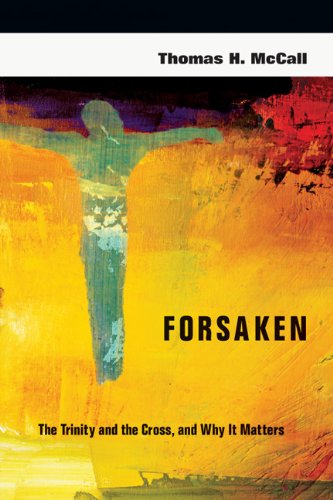
Thomas H. McCall, Forsaken: The Trinity and the Cross, and Why It Matters (Grand Rapids: Eerdmans, 2012), 170 pages, ISBN 9780830839582. Thomas McCall writes this book primarily for pastors, students, and a general audience, unlike his previous sophisticated academic study on the Trinity. In Forsaken, the professor of biblical and systematic theology at Trinity Evangelical…
Michael F. Bird, Jesus among the Gods: Early Christology in the Greco-Roman World (Waco: Baylor University Press, 2022), xi+480 pages, ISBN 9781481316750. To whom or to what might we compare Jesus, the “son of God” (Mark 1:1)? In the hunt to discern the meaning and range of early Christian identifications of Jesus as divine, scholars…
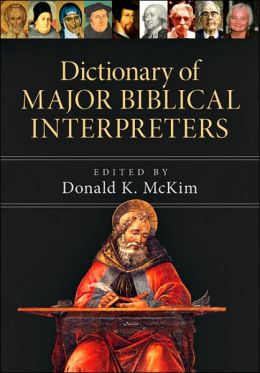
Donald K. McKim, ed., Dictionary of Major Biblical Interpreters (Leicester: InterVarsity, 2007), 1106 pages, ISBN 9780830829279. This book is a revised edition of the Historical Handbook of Major Biblical Interpreters (1998). In concept, the work is ingenious—I know of no other work that treats major figures in the interpretation of Scripture in this way….
Part 1 of a conversation between Lawrence Wood and Frank Macchia on the link between Wesleyan and Pentecostal traditions. Originally posted by the Asbury Theological Seminary. Frank Macchia Frank D. Macchia, ThD (University of Basel, Switzerland) is professor of theology at Vanguard University in Costa Mesa, California. He has served as president of the Society…
To provide the best experiences, we use technologies like cookies to store and/or access device information. Consenting to these technologies will allow us to process data such as browsing behavior or unique IDs on this site. Not consenting or withdrawing consent, may adversely affect certain features and functions.
Functional
Always active
The technical storage or access is strictly necessary for the legitimate purpose of enabling the use of a specific service explicitly requested by the subscriber or user, or for the sole purpose of carrying out the transmission of a communication over an electronic communications network.
Preferences
The technical storage or access is necessary for the legitimate purpose of storing preferences that are not requested by the subscriber or user.
Statistics
The technical storage or access that is used exclusively for statistical purposes.The technical storage or access that is used exclusively for anonymous statistical purposes. Without a subpoena, voluntary compliance on the part of your Internet Service Provider, or additional records from a third party, information stored or retrieved for this purpose alone cannot usually be used to identify you.
Marketing
The technical storage or access is required to create user profiles to send advertising, or to track the user on a website or across several websites for similar marketing purposes.
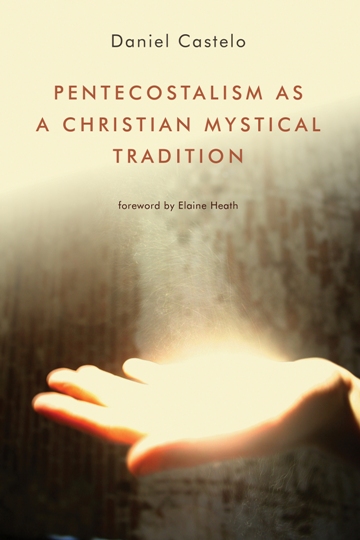

 Daniel Castelo, Pentecostalism as a Christian Mystical Tradition (Grand Rapids, MI: William B. Eerdmans Publishing Co., 2017), 194 + xx pages, ISBN 9780802869562.