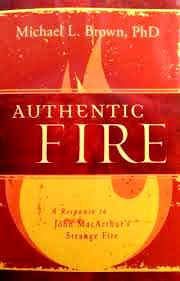
Michael Brown’s Authentic Fire, reviewed by William De Arteaga
Are Pentecostals offering Strange Fire? (Panel Discussion)

Michael L. Brown, Authentic Fire: A Response to John MacArthur’s Strange Fire (Excel Publishers, Dec 12, 2013), 418 pages.
Authentic Fire, by Dr. Michael L. Brown, is a masterful answer to the intemperate and angry attack on Charismatic movement and Pentecostalism by John MacArthur in his work, Strange Fire.[1] In the public launch to Strange Fire, MacArthur made clear his utter disdain for the Charismatic Movement in particular:
Nothing coming from the Charismatic movement has provided recovery or strengthening of the biblical Gospel. Nothing has preserved truth and sound doctrine. It has only produced distortion, confusion, and error. Yes, there are people in the movement who know and love the truth, have an orthodox Gospel, but are heterodox on the Holy Spirit. Not all of them are heretics. But I say again the contribution of truth from the people in the movement doesn’t come from the movement, but in spite of it …[2]
Brown is one of the best-qualified persons in Christendom to answer MacArthur’s accusations. He converted from nominal Judaism into Pentecostal Christianity, and then for a season became a cessationist. However, his careful study of the scriptures showed him that cessationism was indefensible. Subsequently, mission trips to Third World areas showed Brown time and again that today God works powerful “signs and wonders”—just as in New Testament times. Well educated, Michael Brown holds a Ph.D. in Near Eastern Languages and Literatures, his dissertation was on the healing character of God in the Old Testament. He has written multiple books on a whole range of issues, from biblical commentaries to works on revival, and Jewish oriented apologetics.
In his pastoral and teaching roles of the Brownsville Revival, and in his numerous teaching positions at various Pentecostal and Evangelical seminaries, Brown has demonstrated his commitment to the Pentecostal/charismatic appreciation of the gifts of the Spirit. But Brown has also been a critic of the excesses within the Charismatic movement, especially the exaggerated prosperity theology so present in Christian TV ministries. One of his many books, The End of the American Gospel Enterprise, took special aim at this issue.[3] In a recently released book he also criticizes, in his typical respectful but biblically forceful manner, the new “grace message” circulating in some charismatic churches. [4]
In fact, Brown may be considered among a special category of Christian theologian and critics—what I term, “prophetic critics.” That is, one who appreciates and affirms the moves of the Holy Spirit in revivals, but is critical of the improper “spillover” of revival, as when ministries and evangelists go beyond the bounds of scripture. In this august group one should first cite Jonathan Edwards, whose numerous writings both defended the First Great Awakening, but also critiqued its exaggerations.
Many past revivals have had such prophetic critics. For instance, Captain Kelso Carter was a leader of the first healing revival of modern Christianity, the Faith Cure Movement (1880s). However, he saw that many of its leaders were taking a wrong turn in advocating the rejection of medication as being contrary to healing prayer, and critiqued them for this.[5] In the charismatic movement of the 1970s, Charles Farah, Jr., one of the early leaders of that movement, wrote a now classic critical work on the exaggerations of the Word Faith Movement, From the Pinnacle of the Temple.[6] This work strongly criticized some of Kenneth Hagin’s teachings.
However, it has been the sad fate of the Spirit-filled Churches, and much to the disservice of revivals, that these prophetic critics are largely ignored. Thus, with abuses in theology and preaching not sufficiently corrected, God allows another form of critic to arise, much like the Babylonian invaders of ancient Judah, to pillage and lay waste to revivals. This type of critic sees only error and exaggeration in revival. I called this type of critic a “Pharisee” in my earlier work Quenching the Spirit. There I define a Pharisee as an orthodox believer, who has a fine grasp of traditional theology, but cannot recognize a new move of the Holy Spirit.[7] I must note immediately that Brown, who is aware on my work on revivals, does not label MacArthur’s Strange Fire, or his earlier anti-charismatic work, Charismatic Chaos, as works of phariseesism.[8] He does this, I believe, in order to leave a better atmosphere for dialogue with MacArthur and his followers (see below).
Brown’s Authentic Fire is a lengthy work that is divided into ten chapters. The current “E-book” edition, and the only version available at this time of this review, runs to 418 pages, and includes three short appendixes by Pentecostal/charismatic scholars.
Chapter 1 of Authentic Fire documents how MacArthur has declared all-out war on the Pentecostals and charismatics, with his assertions that they have made no positive contribution to Christianity, in ether biblical scholarship, or worship, or anything of value. Brown begins his refutation of these outrageous charges by showing that many non-charismatic church leaders and scholars, not noted for being charismatic, were offended by the tone and exaggerations in Strange Fire. As for instance Timothy George, dean of the divinity school at Stanford University, who calls MacArthur’s approach and accusations, “both myopic and irresponsible.”[9]
In Chapter 2, “Embracing Authentic Fire,” Brown points out that all revivals have had irregular edges where abuses are found, and readily admits to the abuses within the Charismatic movement. However, Brown points out a bevy of leaders (prophetic critics), such as himself and Derek Prince (1915-2003), who have spoken out forcefully against such abuses, as in lack of holiness among many in positions of authority. These critiques seek to separate the good of revival from the exaggerated and unscriptural, but not condemn the whole.
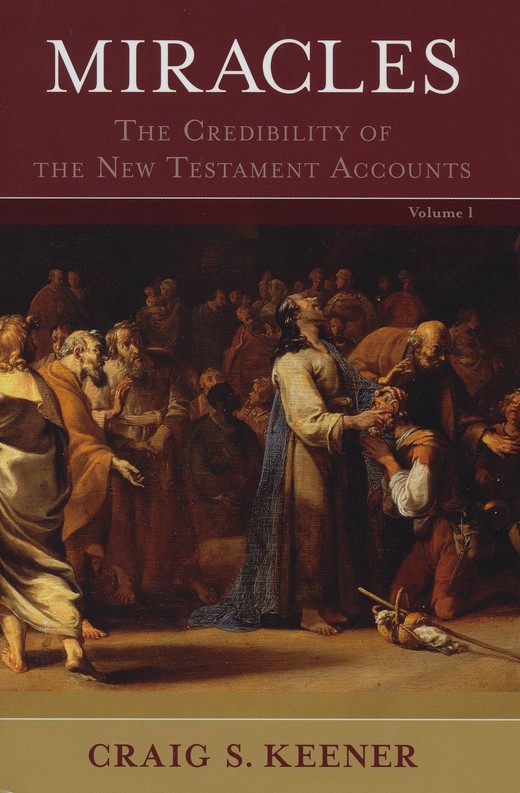
Chapter 3 is titled, “The Great Big Blind Spot.” Here Brown documents how MacArthur has ignored vast areas of evidence of the “good fruit” found within Pentecostalism and the Charismatic Movement. While MacArthur insists that no worthwhile biblical scholarship has proceeded from the Pentecostal and charismatic founts, Brown lists the work of many excellent Pentecostal and charismatic Biblical scholars. He begins by naming Gordon Fee, who for decades taught at Wheaton College and Regent College in Vancouver, both banner Evangelical colleges. Fee contributed a volume to the prestigious New International Commentary series. Another top scholar that Brown cites as making major contributions to Biblical scholarship and understanding is Craig S. Keener. His biblical commentaries have received the “Best Book” award numerous times from Christianity Today—an incredible achievement and honor from America’s banner Evangelical magazine. Brown continues by citing a half dozen other prominent theologians and philosophers who are Pentecostal or charismatic. MacArthur’s charge in this matter is exposed as ignorant and factually in error.
MacArthur stated both in his book and the “Strange Fire Conference” that the Charismatic movement has produced “Nothing that enriches true worship.” Brown points out that the contrary is true. Most evangelical churches incorporate worship music from such charismatic musicians such as Darlene Zschech and the Hillsongs group, Matt Redman, Michael W. Smith, or the numerous praise songs developed out of the Vineyard churches including the song “Isn’t He.” MacArthur’s accusation on this matter becomes utterly astounding.
In Chapter 4, “The Genetic Fallacy and Guilt by association,” Brown shows the many occasions that MacArthur uses fallacious historical argumentation and guilt by association to discredit Pentecostalism. For instance, MacArthur attacks the entire Pentecostal movement because Charles Parham, one of its founders, was a racist. In fact, although Parham accepted segregation, as almost all Americans of his day, he was also ahead of his times in attempting to bring about racial reconciliation. He led inter-racial camp meetings in his home state of Kansas, and was noted in his times for his exceptionally good relations with African-American pastors.[10] The whole argument is fallacious and unbiblical. God often uses imperfect persons to do great things for the Kingdom of God. Brown points out how Martin Luther, the founder of Protestantism, was deeply and barbarically anti-Semitic. Here Brown uses his expertise in Jewish history to lay out the unpleasant facts of Luther’s vitriol towards the Jews and its horrible consequences when his writings were later used by the Nazis to justify the Holocaust.[11]
Chapter 5 centers on countering the MacArthur’s misuse of Jonathan Edwards’ classic view of discerning revivals by “testing the spirits.” Brown very ably summarizes Edwards’ criterion of discernment, and makes note of the fact that Edwards was never upset by the bodily manifestations of revival. That is, that when they occur they could be from God or not, as in a “flesh” desire for attention. MacArthur, on the contrary, ridicules and condemns all bodily manifestations as not from God. In this chapter, Brown also defended the progress and orthodoxy of African Pentecostalism, for which Brown has much personal experience, and MacArthur does not.
Chapter 6, “Sola Scriptura” contains many details of Brown’s journey from Judaism to Pentecostalism, and how he carefully studied the classic works of cessationism such as Benjamin Warfield’s Counterfeit Miracles (1918). But by experiencing God’s presence and love, and seeing His miracles firsthand, he rejected cessationism. The salient point of this chapter is that MacArthur’s claim that his analysis of revivals is based solely on scriptural evidence is false. Rather, MacArthur uses biblical evidence seen only through the lens of cessationism to reach his conclusions.
Chapter 7 entitled, “Shall We Burn One Another?” is a sad reminder of what happens when Christians believe they are so right that we cannot respect other Christian viewpoints (MacArthur’s Calvinist phrase for this attitude is “sound doctrine” which relegates non-Calvinist forms of theology as “unsound doctrine”). Brown gives the reader a tour of Christian vs. Christian persecution down through the ages, from the first street battles between the Coptic and Catholic Christians in North Africa (350 AD), to the Protestant Reformers who murdered the Ana-Baptists for daring to believe that infants should not be baptized. From this sad history, and from the dangers inherent in MacArthur’s sectarian rhetoric, Brown suggests certain principles in dealing with Christians we disagree with, such as the fact that we need each other’s’ insights, even if we disagree, or that, “Surgeons cut carefully,” that is, avoid over generalizations, etc.
 Perhaps the most insightful and original contribution of Browns work is found in Chapter 8: “Spirit and Truth: Right Brain and Left Brain.” Brown points to the scientific understanding of the human ability to know and understand which has been categorized by scientists as either “right brain” or “left brain” mode. That is, the hemispheres of the brain specialize in different modes of understanding. The right hemisphere specializes in emotions, music, images and intuition, and the left brain focuses on language, logic, and critical thinking. Most people favor one hemisphere or another, and thus are either more emotional and intuitive, or mostly logical and critical. Few persons are perfectly balanced. Problems arise when persons with one form of predominance do not recognize the reality of the other form of thinking and understanding. Brown identifies MacArthur as heavily “left brained.” This has allowed MacArthur to be an excellent analyzer of logical issues, such as the linguistic analysis of particular scriptures, but have very poor appreciation of the intuitive, and “mystical” elements that are part of religious experiences. This seems to be the reason why MacArthur, a left brainer, has such poor appreciation of charismatic music, or music in general.[12]
At the Strange Fire conference MacArthur said:
The richer you are in theology, the more elevated your worship becomes. You don’t have to turn the music on for me to worship. In fact, I sometimes wish the music would all go away, and that I didn’t have to deal with sensations along with my thoughts.[13]
This is an incredible statement in view of the role that music plays in scripture, as in the Psalms, which were all meant to be sung.
In Chapter 9, “A God to be experienced” Brown shares some of his spiritual experiences, and fellowship moments with God. He rightly concludes that God should be experienced, encountered and fellowshipped through many ways, as in the logical understanding of Scripture (MacArthur’s predominant way) but also in miraculous events, and the experiences of intense prayer and worship. Brown believes that the Church as a whole needs perspectives, clear, logical biblical analysis, plus spiritual experiences and the gifts of the Spirit. Right and left brained Christians need each other to share their separate but valid insights.
In Chapter 10 the charismatic and Pentecostal readers can see why Brown has been so moderate in his argumentation and language. He wants constant and meaningful dialogue between fervent cessationists and dedicated continuationists (Spirit-filled believers). Brown is optimistic this can happen. And of course all things are possible with God’s grace and fervent prayer.
As an historian of revivals, I am less optimistic. My study of Pharisees has shown them to be usually proud of their “sound doctrine” to the point where dialog is meaningless. Often they are humble in demeanor in person, but theologically and institutionally arrogant. MacArthur certainly is humble in his broadcasts and teachings, but MacArthur’s angry generalizations and fervent exaggeration, and especially his idolization of “sound doctrine” (i.e. his Calvinism) seems more fitting in the 19th Century when sectarianism was much stronger, than in this age where believers need to honor and respect each other to face together a hostile secular culture.
Church history shows that the damage of the Pharisees to the Church can be substantial. However, it is not irreversible, since the Holy Spirit initiates revivals again in other places and time as He tries to mold the Church into its original New Testament pattern of manifesting the gifts of the Spirit in power, and the character of Christ in Love (1 Cor. 12-14).
I strongly recommend Brown’s Authentic Fire for pastors and those in Christian leadership positions, or for those troubled by the Strange Fire controversy. My only criticism is that the text is perhaps too long and might have been edited down some without losing any of its punch. Its length will force a relatively high price for the print edition, and this will restrict its availability.[14]
Reviewed by William L. De Arteaga
[1]Much of the initial response to MacArthur’s Strange Fire book (Nashville: Thomas Nelson, 2013), and its well-staged launch was due to its intemperate nature. See for instance the guarded but negative comments by Mark Galli, editor of Christianity Today, at: “Galli Report”, posted 10/23/13
[2] From MacArthur’s keynote speech at the “Strange Fire Conference,” Oct 16, 2013. Available at www.standfirmfaith.com
[3](Shippensburg: Destiny Image, 1993).
[4]Michael L. Brown, Hyper-Grace: Exposing the Dangers of the Modern Grace Message. (Bridge-Logos, 2013)
[5]Kelso Carter, “Faith Healing” Reviewed After Twenty Years (Boston: The Christian Witness Co., 1897).
[6]Charles Farah, Jr., From the Pinnacle of the Temple (Plainfield: Logos International, 1979).
[7]See my book, Quenching the Spirit, and my strongly worded review of MacArthur’s Strange Fire at PneumaReview.com : “John MacArthur’s Strange Fire as a Parody of Jonathan Edwards” at: /john-macarthurs-strange-fire-as-parody-of-jonathan-edwards-theology-by-william-de-arteaga/
[8] John MacArthur, Charismatic Chaos (Grand Rapids: Zondervan, 1992).
[9]MacArthur, Strange Fire, 6. Dr. George wrote a full-length article response to Strange Fire, which appeared in First Things, a predominantly Catholic, but ecumenical and conservative journal: “Strange Friendly Fire.” http://www.firstthings.com/web-exclusives/2013/11/strange-friendly-fire Posted, 11/04/13.
[10] See Eddie L. Hyatt, “Across the Lines: Charles Parham’s Contribution to the Inter-Racial Character of Early Pentecostalism,” Pneuma Review (Fall 2004). /across-the-lines-charles-parhams-contribution-to-the-inter-racial-character-of-early-pentecostalism (accessed Jan 30, 2014).
[11]I anticipated Dr. Brown’s comments on Luther as an imperfect spiritual leader/pioneer in my review of Strange Fire in Pneuma Review (above).
[12]In my own studies of the opposers of revivals, the “Pharisees”, I noted how compulsively orderly and logical these persons were. See especially my study of the Rev. Charles Chauncy, the “Pharisee” of the First Great Awakening, in Quenching the Spirit, chapter 3, but I did not relate this characteristic to the left/right brain divide. Dr. Brown’s insight helps understand many contentious issues of church worship and disputes in theology.
[13]Cited by Brown in Authentic Fire, p. 285.
[14] Ibid., 13.






TW writes: "A definitive response to *Strange Fire* by MacArthur. *Authentic Fire* shows the inadequate and exaggerated accusations for what they are. Yes, there is a real pentecostal experience for the modern Christian. Avoid the excesses and receive the reality of God."
JS, friends with Fr. Bill De Arteaga, writes: "Good review, Father."
RP writes: "How the churches love the music from each movement of God, even though some reject the sign gifts."
GM, in the Society of Vineyard Scholars Facebook group, says: "I will have to read it… I read MacArthur's "Charismatic Chaos" years ago and found it to be less than a formidable challenge to Charismatics. In fact, the weakness of his arguments surprised me from one as brilliant as he. I suppose that I will have to first read his "Strange Fire" also, though the prospect of doing so has bored me even before beginning."
WS writes: "I am looking forward to reading this book. I'm currently reading Strange Fire, and I look forward to seeing Brown's opinion also."
Pastor Timothy Waisanen writes: “A definitive response to *Strange Fire* by MacArthur. *Authentic Fire* shows the inadequate and exaggerated accusations for what they are. Yes, there is a real pentecostal experience for the modern Christian. Avoid the excesses and receive the reality of God.”
WS writes: “I am looking forward to reading this book. I’m currently reading Strange Fire, and I look forward to seeing Brown’s opinion also.”
GM, in the Society of Vineyard Scholars Facebook group, says: “I will have to read it… I read MacArthur’s “Charismatic Chaos” years ago and found it to be less than a formidable challenge to Charismatics. In fact, the weakness of his arguments surprised me from one as brilliant as he. I suppose that I will have to first read his “Strange Fire” also, though the prospect of doing so has bored me even before beginning.”
RP writes: “How the churches love the music from each movement of God, even though some reject the sign gifts.”
JS, friends with Fr. Bill De Arteaga, writes: “Good review, Father.”