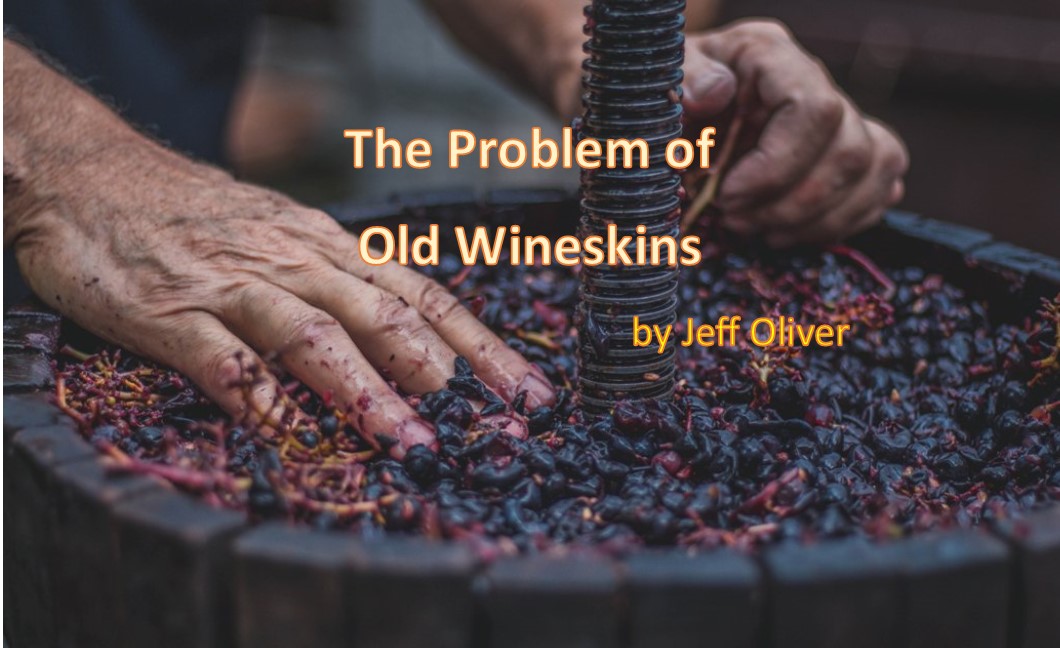
The Problem of Old Wineskins

Jeff Oliver, author of the three-volume Pentecost to the Present: The Holy Spirit’s Enduring Work in the Church, brings a challenge to church leaders: desire and operate in the gifts of the Spirit.

The greatest problem facing the church today may not be a new one, but an old one. Jesus said, “No one pours new wine into old wineskins; otherwise the skins will burst and the wine will pour out and the skins will be destroyed. Instead they put new wine into new wineskins and both are preserved.”
Jesus was responding to a question asked by John’s disciples, “Why do we and the Pharisees fast and your disciples do not?” He was illustrating the difference between John’s ministry and that of his own. John came to call to repentance those who were steeped in the traditions of Judaism. Jesus, however, had not come to patch up the old system or to pour new wine into an old vessel. He came to begin anew. Neither the teachings nor the works of Jesus could be contained in an old rigid legalistic system. This would require something stronger, more tender and pliable. Jesus’s gospel was the very power of God, as were his works. John himself explained the difference between the two ministries when he said, “I baptize you with water for repentance. But after me will come one who is more powerful than I … He will baptize you with the Holy Spirit and with fire.”
New Wine for New Wineskins
Yet this was only the first of many times the Holy Spirit would be poured out on Christ’s new wineskins—his church. In Acts 3, Peter said multiple “times of refreshing” would come from the presence of the Lord. This happened in Samaria (Acts 8:17) at Saul’s conversion (Acts 9:17) in Cornelius’s house (Acts 10:44) in Ephesus (Acts 19:6) Corinth (1 Cor. 2:4) Rome (Rom 12:6) Galatia (Gal 3:5) Thessalonica (1 Thess. 1:5) among a group of unnamed Hebrews (Heb. 2:4) and in countless other places and regions in the Roman Empire and beyond. On and on through history numerous times of refreshing occurred—far too many to mention here (see Pentecost to the Present: The Holy Spirit’s Enduring Work in the Church). With each occurrence, the church preserved the work of the Spirit and the work of the Spirit preserved the church.
Today’s Old Wineskins
Today’s “old wineskins” are, for the most part, the churches of Europe, North America and other westernized nations, many of which may outwardly appear to be new, modern, and contemporary, but inwardly are still “old wineskins” because they no longer preserve the work of the Holy Spirit. Unfortunately, neither can the work of the Spirit any longer preserve these churches. Thus, the dichotomy—Christianity continues to grow steadily worldwide, while in the West, it remains in a state of freefall.

Scholars and experts agree a major reason for this is because the Western church has forsaken a supernatural God. When people come to Christ in the emerging world, much like the apostle Paul, whose words came in demonstration of the Spirit and power, church leaders provoke their imaginations with something they can see, hear, and experience. While in the West, all we offer is talk, good morals and politics. Philosopher Peter Kreeft called this “the master heresy of our civilization…a loss of belief in the supernatural.” J.D. King, Director of World Revival Network, calls it “abandonment of the miraculous.” Call it what you will, the problem is old wineskins.
Why Westerners Reject the Supernatural

Seeker-friendly or Spirit-friendly?
They mistakenly believe, to be culturally relevant, seeker-friendly, or to attract as many as possible to Christ, they must “tone down” spiritual manifestations. Otherwise, seekers, newcomers, and those weak in the faith may become frightened. They mistakenly believe they can reach more people without the Holy Spirit than with, and win more to Christ in their own strength than by the power of God. The apostle Paul believed the opposite: “Rather than using clever and persuasive speeches, I relied only on the power of the Holy Spirit.” (1 Cor. 2:4 NLT). Again, he wrote: “So I have reason to be enthusiastic about all Christ Jesus has done through me in my service to God. Yet I dare not boast about anything except what Christ has done through me, bringing the Gentiles to God by my message and by the way I worked among them. They were convinced by the power of miraculous signs and wonders and by the power of God’s Spirit.” (Rom 15:17-19 NLT)
Disuse or Proper Use?
Still other Western church leaders take a “balanced” approach to spiritual gifts, but a balance between what? Jesus said to the Laodicean church: “I know your works, that you are neither cold nor hot. I wish you were cold or hot. But because you are lukewarm, and neither cold nor hot, I will vomit you out of my mouth.” Unfortunately, there is no middle ground when it comes to the Holy Spirit—we either accept Him or grieve Him, embrace Him or quench Him.

A Biblical and Historical Precedent
Sure, if we pull out all the stops, we will lose some people, but our gains will be far greater. This is biblically and historically true. The late Peter Wagner, who studied church growth for more than fifty years, concluded: “I noticed that the churches worldwide that seemed to grow the most rapidly were, for the most part, those that outwardly featured the immediate present day supernatural ministry of the Holy Spirit.”
We need only relearn a lesson Aimee Semple McPherson learned in her own lifetime. By 1919, Aimee had crisscrossed America several times holding Pentecostal tent meetings. But as the crowds grew larger and larger, she thought she might need to “cool down” the manifestations of the Spirit so as not to frighten away newcomers. At Baltimore’s Lyric Opera House, a woman, filled with the Spirit, ran up and down the aisle. Aimee had her removed. Eventually Aimee herself stopped speaking in tongues publicly. But by the 1930s, after she had founded Angelus Temple—America’s first megachurch, and her ministry had become crippled by her infamous kidnapping incident, and the nation had fallen deep into economic depression, Aimee grappled with how to revitalize her ministry. She quickly shed her Hollywood celebrity image, began ministering to the poor and disenfranchised again, returned to her Pentecostal roots, brought back the power of God to her meetings, and started speaking in tongues publicly again. Aimee’s later years were greater than her former, and today her legacy lives on in some 8 million Christ-followers in 144 nations. Aimee reintroduced a supernatural God to her generation and we must do the same today.
The SBC and Biola University
Today, many are heeding that call—including some who have not historically embraced the supernatural. They are getting with God’s program and with what the Holy Spirit is doing in our world today, lest they be left behind. In 2015, the Southern Baptist Convention’s International Mission Board voted for the first time in its history to admit missionary candidates who speak in tongues. Why? They realized if they wish to remain among the world’s most powerful missionary forces, they must accept what God is doing and can no longer afford to distinguish themselves as “the denomination that does not accept speaking in tongues.”
Likewise, Biola University, a Southern California Christian school with strong evangelical and fundamentalist ties, announced in 2017 that it was offering courses on the Holy Spirit’s work in the world today. Biola’s President, Barry Corey, offered two reasons for this: “the challenges we face in a rapidly changing, secularizing context” and “to tap into the Spirit’s power…and celebrate His movement in the wider world.” Biola’s leadership realized they must have the power of the Holy Spirit in a hostile and anti-Christian culture. An aged John Wesley realized the same when he prayed, “Oh, Lord, send us the old revival, without the defects; but if this cannot be, send it with all its defects. We must have revival.”
PR
This article has been reprinted with permission from www.globalwakening.com.