Sarah Withrow King: Animals Are Not Ours (No, Really, They’re Not)

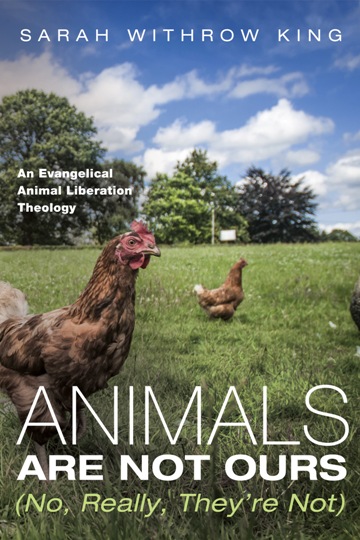
 Sarah Withrow King, Animals Are Not Ours (No, Really, They’re Not): An Evangelical Animal Liberation Theology (Cambridge: The Lutterworth Press, 2016), v + 184 pages.
According to the back cover, King is Deputy Director of the Sider Centre at Eastern University. She is just another Christian leader to add her voice in a growing choir supporting the animal liberation movement started by Dr. Andrew Linzey in 1976. This book is her attempt to help convince Evangelicals (i.e. those that believe the Bible and that Jesus is Lord and Savior who died and rose again to save us from our sins) to care about animals suffering and death as well as to provide advice for how to live out that care in practical terms.
The book is organized into three sections. Part 1, Looking at the Word through the Animal Lens, seeks to convince Evangelicals that our understanding of dominion and use of animals stems from a misreading of Scripture. Drawing heavily from the theologies of Andrew Linzey and Jürgen Moltmann (and others), King argues that humans should see our roles towards animals as servants and fellow creatures serving God. She asserts that God commanded a vegan diet (based on Genesis 2) and that our misunderstanding of dominion has led us to the mistaken belief that we can use violence against our fellow creatures, the animals.
In Part 2, Intersection and Bridges (The Oppression Connection), she turns to discuss more philosophical issues such as animal suffering (does it matter?), being human, hierarchy as a heresy, creation care, pro-life as including animals, and more. The goal of this section is simple. First, she wants to exploit our tendency to have compassion by emphasizing the myriad number of ways we cause animals to suffer. Second, she seeks to break down the notion that our status as humans gives us the right to harm and eat animals. Third, she argues for humans to be consistently non-violent both with each other and towards animals, our other neighbor.
With Parts 1 and 2 in hand, King turns to tell readers how to live out their new-found compassion in concrete terms. Part 3, Now What? The Basics of Treating Animals Well, provides a series of actions to help readers adopt a vegan diet and cruelty free lifestyle. King provides advice on how to start (begin with baby steps) and how to communicate with your non-vegan friends. She is both encouraging and gives specific, and frequently, absolutist directives on how followers should behave to achieve cruelty-free status.
This book is different from other food morality books I have read and/or reviewed in that King comes to the subject not as an intellectual but as a social change warrior. She actually worked for the shock-lobby group, People for the Ethical Treatment of Animals, otherwise known as PETA. I have no doubt that she is a true believer in the food morality movement. I can respect her for at least trying to integrate her faith in Christ with her ideology. Too many Christians live schizophrenic lives. I do not believe that she does and I think that says something positive about her character.
Unfortunately for readers, the book contains several significant weaknesses. First, the text lacks sufficient focus. For instance, King quickly moves from talking about the alleged horrors of intensive fish production (often called factory farming) to research on mice and rats. Granted she dislikes them both but are they morally equal? Her failure to engage the subject matter at a deeper level is demonstrated by her ignoring Christ’s behavior that appears antithetical to her opinion such as Christ’s treatment of fish (see pp.52ff; 66). Second, like many Christian animal activists, she ignores evidence that diametrically opposes her position. Now granted, many scholars never allow evidence to get in the way of a good theory. So, King is in good company here. But I want readers of this review to know that there is a lot of counter-evidence against her view and that of others in the Christian animal protectionists movement. My dissertation and subsequent publications discuss many of them (see Dominion over Wildlife? An Environmental-Theology of Human-Wildlife Relations, 2009), but I will list a few of them here. Consider the following passages and ask yourself: Do these passages support to the notion that Christ came to stop animal suffering through His reconciling work?
- Isaiah 25:6. In the eschaton, YHWH will provide a feast with bone-marrow on the menu.
- Luke 15:23. The Prodigal Son parable mentions a fatted calf. Have you thought about how the calf got fattened up?
- Matthew 8:30 and parallels. If Christ cared so much about animal suffering, why did He send the demons into swine? Why did He not save them from drowning or resurrect them when they did?
There are many more. Note, I have not even discussed how her interpretation of various passages (e.g. Deut. 25:4; Isa. 11:6) fail under exegetical scrutiny. Likewise, her treatment of words exemplifies the error known as illegitimate semantic totality transfer. For example, on p. 32 King claims that Joel’s prophecy concerning God’s promise to pour out His spirit on all flesh includes animals (Acts 2:17; Joel 2:22-28; see p. 77) presumably because animals also have flesh. It does not seem to occur to her that flesh may be used more narrowly here to refer to humans.
Third, King makes many assertions without references to support them. On page 68, she claims that animal testing is less accurate than other types of studies designed to study product safety. She may be correct. But without a reference, we just have to take her word for it.
There is much to criticize in this book, but I suspect readers get the idea. Nevertheless, if you are looking for more rules to follow, then I would highly recommend this book. King provides many rules to live by that will help you suffer under the bondage of another legalism, should that be your desire.
Reviewed by Stephen M. Vantassel
USA Publisher: https://wipfandstock.com/animals-are-not-ours-no-really-they-re-not.html
UK Publisher: http://www.lutterworth.com/product_info.php/products_id/2687